
A first discussion with a NIS2 specialist rarely begins with a final quote or a completed work specification. Usually the organisation first needs to assemble basic information: what it does, which processes are critical, the shape of its IT environment, who is responsible for security and whether its readiness has previously been reviewed.
Good preparation does not mean independently resolving legal or technical obligations. It means gathering facts that help the provider understand the situation and suggest a sensible next step.
Not every organisation starts from the same position. One may still need to establish whether NIS2 applies to it under the relevant national implementing legislation. Another may already have a management decision and want to discuss implementation. It helps to choose the appropriate NIS2 route before discussing exact deliverables.
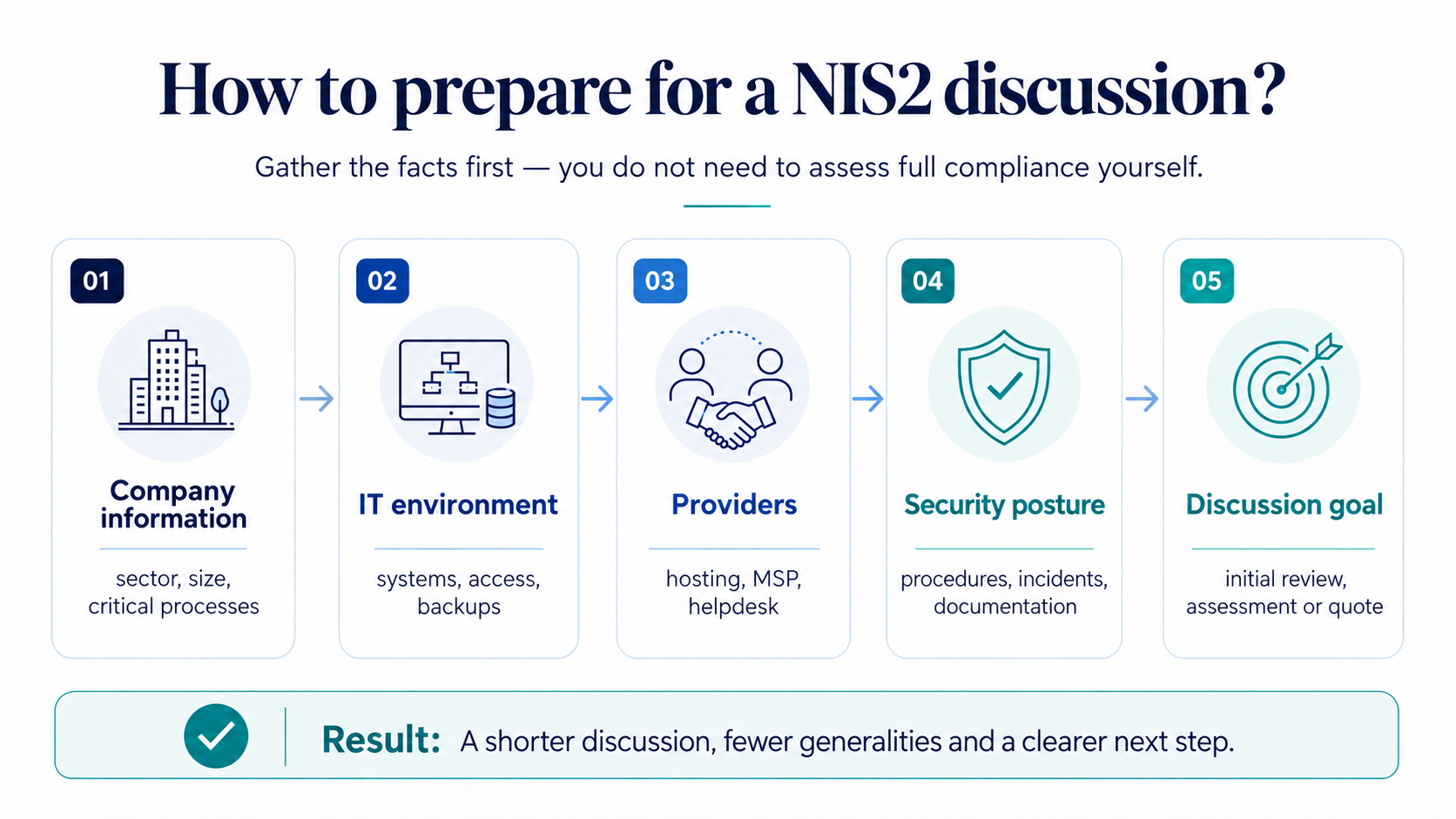
The diagram illustrates five groups of information to organise before talking to a provider.
Where a NIS2 discussion usually begins
In many organisations NIS2 involves several people simultaneously: management, IT, compliance, legal, operations and supplier management. This is natural because NIS2 concerns more than technology. It also involves responsibilities, business continuity, incident response and risk management.
The initial provider discussion may therefore be about identifying the organisation's current position rather than buying a pre-specified service. An organisation still checking whether the rules apply is in a different position from one with a gap report or an implementation decision.
Prepare to discuss industry and business scale, but also the IT model, suppliers, previous incidents, security-process maturity and deadlines.
Basic information about the organisation
Start with a short organisational profile. It does not need to be formal. A working note is enough to avoid overly general answers.
| Area | What to prepare | Why it helps |
|---|---|---|
| Activity | Industry, types of customers and principal products or services | Puts NIS2 in a real business context |
| Scale | Number of staff, sites, subsidiaries or branches | Helps gauge organisational complexity |
| Geography | EU countries where the relevant services are provided, and any wider operations | May affect organisation of processes and applicable national requirements |
| Critical processes | Activities whose interruption would seriously affect the business | Helps identify key risks and dependencies |
| Responsibility | IT, cybersecurity and compliance owners | Identifies who should attend the next discussion |
| Classification | Essential entity, important entity or “not sure” | Shows whether the organisation's status has been assessed |
These facts do not determine the service scope by themselves. They help the discussion progress from generalities to concrete issues.
How to describe current cybersecurity arrangements
The second step is to describe how security is managed today. You need not have every answer. Gaps in the available information are also useful to identify.
| Security area | Example question | Possible preliminary answer |
|---|---|---|
| IT systems | Which systems are critical? | ERP, email, manufacturing systems, CRM, order platform |
| IT environment | Cloud, on-premises or hybrid? | Cloud / on-premises / hybrid / managed by an external MSP |
| Access | Who grants and removes user permissions? | Internal IT, managed service provider or department managers |
| Backups | Do you know what is backed up and how often? | Yes / partly / not sure |
| Incidents | Has there been an incident or suspected incident? | No / suspected / confirmed |
| Suppliers | Which IT services are outsourced? | Hosting, maintenance, helpdesk, security |
| Documentation | Are there policies, procedures or older reports? | Yes / partly / outdated records |
This is not a replacement for the provider's assessment. It shows which facts are ready and where further discovery is needed.
Define what the organisation needs at this stage
Several different needs are often mixed into one enquiry. A company may want to know whether NIS2 applies, review existing controls, understand the likely work and prepare for implementation — all at once.
That is understandable. Still, it helps to name the main objective before contacting a provider.
| Organisation's situation | A natural direction for the discussion |
|---|---|
| Not sure whether NIS2 applies | Initial review of status and applicable duties |
| Knows NIS2 is relevant, but not the gaps | Diagnose the current state and priorities |
| Already has a gap report | Discuss remediation and sequence of work |
| Management needs a budget decision | Clarify scope before discussing costs |
| Several systems and suppliers are involved | Identify critical dependencies and owners |
| There is a fixed deadline | Prioritise rather than trying to do everything simultaneously |
If a business understands that NIS2 is relevant but has not mapped gaps, priorities and accountabilities, a NIS2 readiness assessment may be a sensible next step.
Assessment or implementation: do not confuse the stages
Discussions about NIS2 often mix two stages: diagnosis and delivery. A company may request “implementation” without knowing the gaps, scope or priorities. It may ask for an indicative cost without knowing whether the project involves governance, documentation, technical safeguards, staff training, supplier management or a complete compliance programme.
| Stage | When it makes sense | Typical discussion outcome |
|---|---|---|
| Initial orientation | Applicability and scope are still unclear | Decide whether more diagnosis is needed |
| Readiness assessment | Need to identify gaps, priorities and a plan | Improvement areas and sequence of action |
| Implementation / compliance programme | Work has been approved or scope defined | Delivery approach, timeframe and terms |
| Implementation quote | Need costs after a brief review of the requirements | Clarified scope and commercial terms |
If the organisation has already decided to proceed, an NIS2 implementation quote may be the more natural route. The discussion then turns to the workstreams, maturity, IT environment, schedule and whether governance and technical measures are both required.
Who should prepare the information?
NIS2 is rarely the responsibility of one person. Even if management or compliance leads the discussion, important information may come from IT, operations, security, procurement and external providers.
Typical contributions include:
- Management: business priorities, accountability and budget decisions.
- IT: critical systems, access, backups, infrastructure and technical suppliers.
- Compliance or legal: existing assessments, documented policies and organisational duties.
- Operations or administration: internal processes and working procedures.
- Procurement or contract owners: critical suppliers and responsibilities.
Not every business has a formal department for each of these roles. In a smaller organisation one person may cover several areas. What matters is knowing who can answer the key questions.
What you do not need to prepare independently
Before first contact you do not need complete compliance documentation or a self-certified legal assessment. Over-preparation can delay the conversation if the company tries to solve a problem that first requires professional scoping.
At this stage you do not need to:
- write your own legal opinion;
- create a complete compliance map;
- classify every gap independently;
- produce a final implementation specification;
- request several detailed competing proposals before the scope is clear;
- resolve detailed technical questions without responsible IT staff.
A good enquiry does not need a completed work specification. It should show what the company knows, what remains unclear and who can provide missing information.
An overly general enquiry and a better one
The least helpful enquiries are often the shortest.
Overly general
Please send us an offer for NIS2.
This gives no indication whether the business needs an applicability review, current-state assessment, action plan, documentation, technical support or later implementation.
Better prepared
We are a B2B manufacturing company with around 120 employees and several key IT systems, partly maintained by external suppliers. We do not yet have a full current-state assessment. We want to establish whether and to what extent we need to prepare our organisation for NIS2 under the applicable national rules, and where to begin.
This is not a substitute for a professional consultation, but it helps identify the right route more quickly.
Short checklist before the first discussion
Gather at least some of the information below.
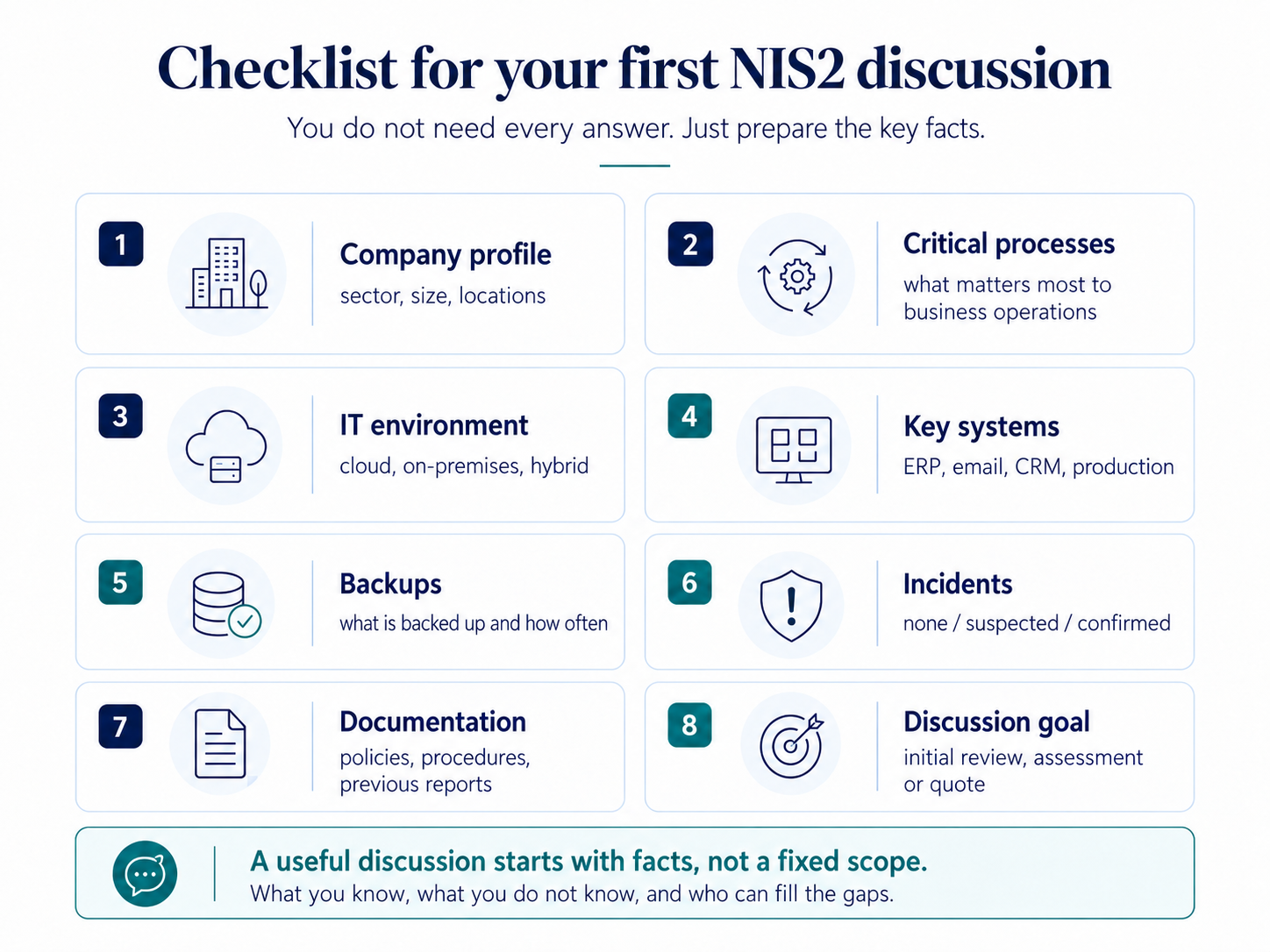
The checklist groups the main facts to collect before discussing NIS2 readiness.
You do not need every answer. You do need to distinguish what is already known from what must still be gathered.
Summary
A well-prepared NIS2 conversation does not mean presenting a complete solution. It means describing the business situation clearly: activities, scale, critical systems, responsibilities, suppliers, earlier work and the main aim of the discussion.
That preparation helps distinguish initial orientation from readiness assessment and later implementation. It also enables the provider to ask relevant questions from the outset instead of beginning with a conversation that lacks context.
Most importantly, the business does not need to know everything. It needs to know what it already knows, what it does not know and who can help fill the gaps.