
In many companies, the ISO topic arises suddenly: a customer requests a certificate as a condition for continuing business, or tender documents specify a certified management system. Time pressure is real because the ability to respond may determine whether the company wins or retains a contract.
That is not the only reason businesses start discussing ISO. Some want to organise internal processes, prepare for larger future customers or improve market credibility before anyone asks for certification. Whatever the trigger, the first discussion with a provider is more productive if you know what you need to establish before asking about scope and cost.
What exactly needs to be clarified
ISO is not one topic but a family of standards covering areas such as quality management, information security, the environment and other management systems. Before sending an enquiry, establish a few basic facts.
First, identify the specific standard. Sometimes the tender documentation or customer requirement names it explicitly. Sometimes the business only knows that "the customer wants ISO" without specifying which standard. That is the first thing to clarify, preferably with the organisation setting the requirement.
Second, establish the scope. A management system may cover the entire company or a selected part of its activity, one site or several branches. The scope affects the work required for implementation and the time needed before a certification audit.
Third, confirm the deadline. Tender and customer requirements often include a specific cut-off date. Find out how much time remains. This determines whether the discussion should begin with a current-state assessment or with a realistic delivery plan for the time available.
Fourth, review existing processes and documentation. Some companies have partially established procedures; others are starting almost from zero. That difference can materially affect the provider's work.
What to prepare before speaking to a provider
The table below shows key information worth gathering before submitting the enquiry.
| Area | What to clarify | Why it helps |
|---|---|---|
| Standard | The specific ISO standard required by the customer or tender | Prevents the conversation from starting with a vague request for "ISO" |
| Scope | Entire business, selected activity, one site or several locations | Determines project scale and implementation time |
| Deadline | Cut-off date from a tender or customer agreement | Helps assess a realistic schedule and priorities |
| Processes | Existing documented procedures, instructions and records | Shows whether you are improving current processes or starting from scratch |
| Documentation | Quality policy, registers or management system documents already available | Helps assess how much work remains before an audit |
| Ownership | Who coordinates the project and can gather cross-department information | Makes communication with the provider more effective |
| Previous experience | Earlier certifications, external audits or another management system | Indicates familiarity with management system requirements |
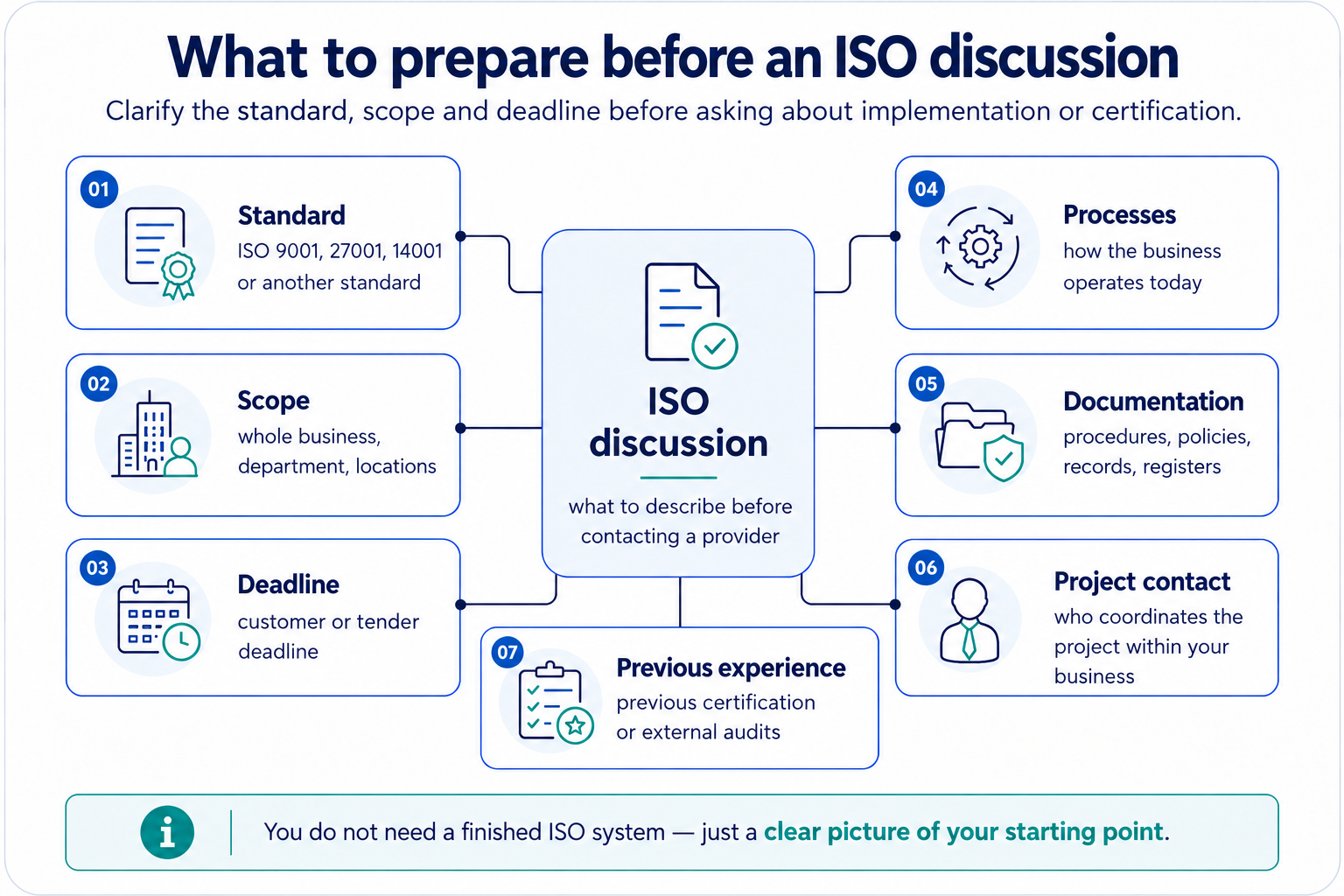
The diagram shows the key information to organise before discussing ISO implementation or certification.
This list does not replace a discussion with a qualified provider. It helps avoid using the first call to establish facts that the company could reasonably have clarified beforehand.
When to start with an assessment and when to ask for a quote
If the company does not know how close it is to certification readiness — perhaps the processes have not been evaluated, the scope is unclear or the issue is only being explored — an ISO readiness assessment is a natural starting point. It can show which management system elements already exist and which still need to be built.
If the standard, scope and deadline are known, and the main question is what must be done, how long it could take and what preparation for certification involves, an ISO implementation and certification preparation quote may be more suitable. The conversation can then move directly to deliverables, timing and service terms.
Businesses facing a tender deadline sometimes want to skip this choice and ask immediately for a price. That is understandable, but without basic information about the current processes, a provider's answer is likely to be very general or subject to substantial qualifications.
Short checklist before submitting an enquiry
Before enquiring about ISO, gather these facts. They do not all have to be complete, but they should describe the company's starting point.
- Which ISO standard is required or being considered?
- Is the requirement from a customer, a tender or an internal business decision?
- Will certification cover the whole company, a business unit, one site or several branches?
- What is the deadline, and is it set out in tender documents or a customer agreement?
- Are processes, procedures, instructions or records already documented?
- Has the company previously undertaken an audit, certification or implementation of another management system?
- Who will coordinate the project internally and collect information from departments?
- Does the company want to assess readiness first, or immediately discuss delivery scope and a timeline?
The checklist does not replace the provider's professional judgement. It helps prevent a vague response caused by missing context.
The most common mistakes at the outset
The first mistake is asking for ISO without naming the standard. "We need ISO" does not tell a provider whether the question concerns quality, information security or another management system.
The second mistake is omitting the deadline. When certification is a tender requirement, the date is one of the most important facts in the enquiry. Yet it is frequently raised only during the discussion rather than in the initial request.
A third mistake is treating implementation and certification as one step carried out by one provider. Preparing a management system and formally certifying it are often separate stages, sometimes performed by different organisations. It is useful to understand that distinction before making contact.
The fourth mistake is not describing existing processes. A business that omits the fact that it already has procedures may receive a proposal assuming the system must be built from scratch, making scope and timing unnecessarily difficult to discuss.
An example of a weak and a better enquiry
Weak enquiry:
Our customer requires ISO. Please send a quote.
This does not identify the standard, scope, deadline or the company's starting point.
Better enquiry:
A tender we are bidding for requires ISO 9001 certification covering the whole company. The bid deadline is in two months. Some of our procedures are documented, but we have never completed formal certification. We want to establish whether the deadline is realistic and what work would be involved.
The second enquiry does not prejudge the answer, but it makes the standard, scope, deadline pressure and starting position clear. That is enough to make the initial discussion about concrete issues rather than basic definitions.
Summary
Whether ISO becomes relevant because of a customer requirement, a tender condition or a business decision to organise processes, discussions go more smoothly when the company knows which standard is involved, the intended scope, the time available and the current state of its procedures.
You do not need a complete answer to every question before first contact. What matters is distinguishing what is already known from what needs to be established — and deciding whether the natural starting point is a readiness assessment or a discussion of implementation scope, timing and terms.