
In many businesses, GDPR compliance was treated as a one-off project: during the initial implementation, following changes in legislation, when a website was launched, or during a broader documentation update. The documents were then saved in a folder, the privacy policy was published on the website and data-processing agreements became a routine part of working with suppliers.
Several years later, the main issue is often not a lack of GDPR documentation. More commonly, the organisation now operates differently from when the documents were created.
Systems, forms, marketing tools, recruitment processes, IT suppliers or customer-service arrangements may have changed. The documentation still exists, but it does not always reflect how personal data is actually handled today.
This is why, before speaking to a specialist, it is useful not only to collect documents but also to consider what has changed since GDPR was last reviewed.
GDPR documentation becomes outdated as the business evolves
GDPR documentation does not age simply because time passes. It becomes outdated most often because business practices change.
A new CRM may introduce different sources of contact information. A new recruitment form may change the categories of candidate data collected. An external email-marketing tool may introduce another processor who needs to be reflected in agreements and process records. Expanding an online shop, customer portal or ticketing platform may change how data enters the business and who can access it.
From the outside, this still looks like the same topic: "GDPR in our company". But the underlying facts have changed, and those facts determine whether the documents and procedures are still consistent with reality.
What matters is whether the documents still reflect how the company actually collects, uses and shares personal data.
Areas that most often need reviewing
Not every organisational change calls for a complete rewrite of the GDPR documentation. It is useful, however, to know which areas tend to create discrepancies between written rules and actual practice.
| Area | What may have changed | What to check before speaking to a provider |
|---|---|---|
| Systems and tools | New CRM, ERP, HR system, shop, newsletter or helpdesk | Do the documents describe the current systems and data flows? |
| Suppliers | New IT, hosting, marketing, accounting or recruitment providers | Are processor agreements and the supplier register up to date? |
| Forms | New contact, registration, enquiry or recruitment forms | Do the data categories and consent mechanisms match what is collected? |
| Marketing and sales | New campaigns, contact databases, automation or remarketing | Are notices, consents and data sources consistent? |
| HR and recruitment | New tools, onboarding processes and employee records | Is the current handling of candidate and employee data documented? |
| Incidents and individual rights requests | Changed responsibilities or unclear procedures | Is it clear who responds and where requests are received? |
| Privacy policy | New website or application processes | Does the policy reflect the actual collection channels? |
This list is not a substitute for a professional review. It helps establish whether the business needs a limited update or a broader assessment of its present position.
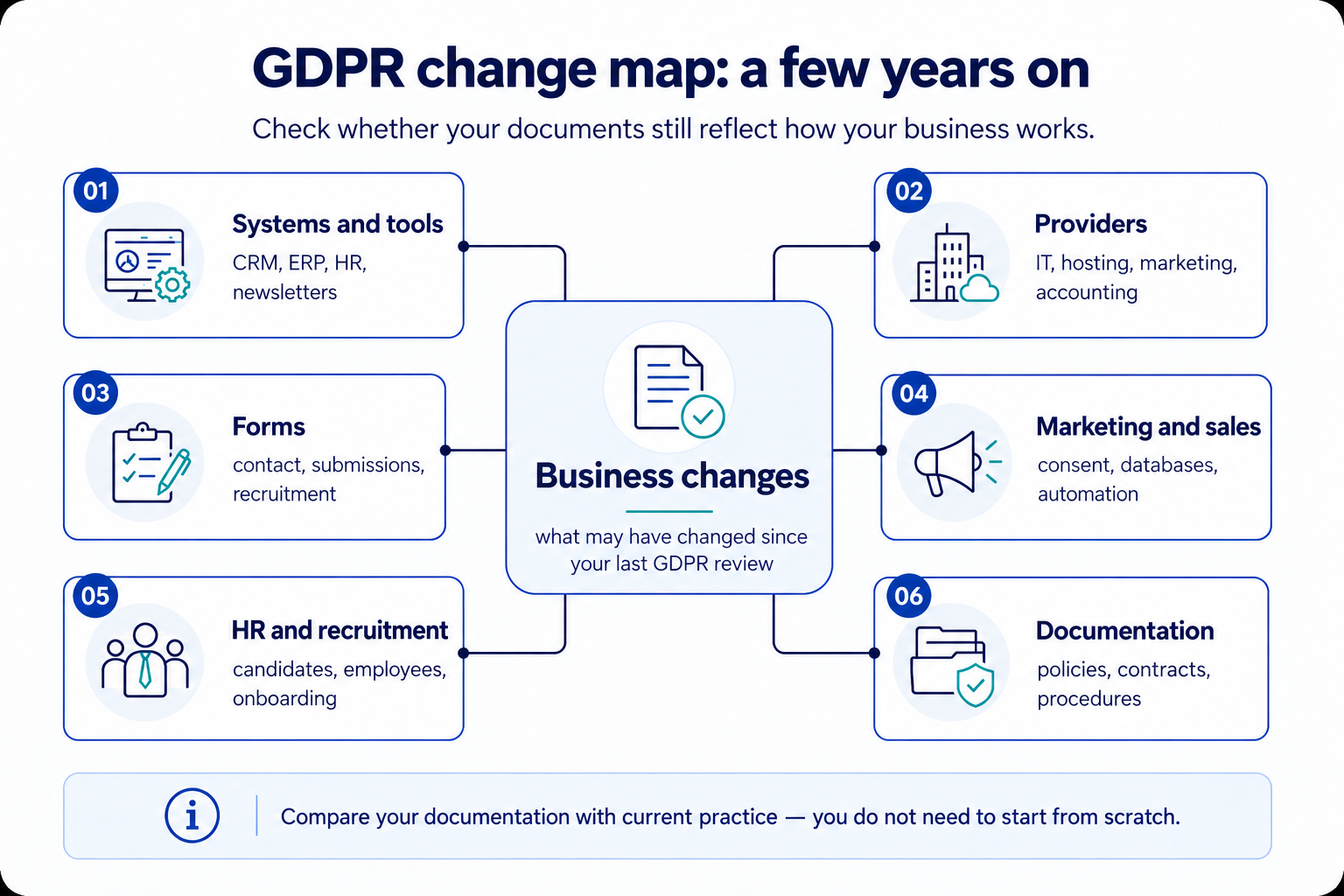
The diagram shows where GDPR documentation can stop reflecting actual business practices.
Example: the documents still exist, but the business now works differently
Imagine a company that organised its GDPR work several years ago. At the time, it had a simple website, one contact form, a basic recruitment process and a handful of established suppliers.
Since then, it has launched a newsletter, replaced its CRM, adopted an external recruitment tool and moved part of customer support into a new ticketing platform. An external agency now runs its marketing campaigns.
The GDPR documents still exist. Yet some may no longer describe today's processes. The privacy policy might omit new forms. The supplier list could be incomplete. Processor agreements may not cover recently adopted tools. Employees may also be unsure who is responsible for keeping those records updated.
In this situation, asking "Do we have the GDPR paperwork?" is too broad. The better question is: which GDPR arrangements still reflect how the company operates today?
What to gather before speaking to a provider
You do not need to produce a full assessment or decide for yourself whether every document is correct. It helps to gather basic facts about the changes in the business.
Consider these questions:
- When was GDPR documentation last reviewed?
- Have systems, forms or suppliers changed since then?
- Have you introduced new marketing, sales or recruitment activities?
- Are there new personal-data categories or groups of individuals whose data is processed?
- Does the current privacy policy describe the important forms and contact channels?
- Do you know who is responsible for consent records, processor agreements, rights requests and incidents?
- Is there an up-to-date list of suppliers with access to personal data?
- Is documentation stored in one place or spread across departments?
Incomplete answers do not necessarily mean there is a major problem. They signal which uncertainties should be clearly explained before the conversation.
What you do not need to decide on your own
A common mistake is attempting to determine whether the business is "GDPR compliant" before approaching a specialist. That can delay the discussion unnecessarily.
At the enquiry stage you do not have to:
- judge the legal validity of every notice and consent;
- create a complete data-processing map;
- determine which supplier agreements are adequate and which need changing;
- interpret detailed legal obligations;
- prepare a fully defined work specification for the provider.
Start with the facts: what changed, which documents exist, where the uncertainty lies and who can supply further information.
If many things have changed and you do not know where to start, discussing a GDPR current-state assessment may make sense. If you already have a defined list of improvements, it may be easier to discuss the scope and cost of implementation.
The main risk: documents detached from practice
Under GDPR, merely having documents is not enough if they no longer describe how the organisation operates. The biggest risk is when the paperwork evolves independently from day-to-day processes.
One example is a privacy policy that describes only a contact form despite the business using a newsletter, online recruitment and analytics tools. Another is a supplier register that omits systems now used by marketing, HR or customer service.
In the discussion with a specialist, show not only the documents but also the real changes in the organisation. That will help establish whether a few targeted updates are sufficient or a broader review is needed.
Summary
Time passing alone does not mean you need to restart your GDPR work from scratch. The more common reason for a review is that the company has changed: its systems, suppliers, forms, HR activities, marketing, sales or customer-service processes.
A productive conversation does not need to begin with a ready-made list of fixes. Gather information about what changed, which documents exist and what you are unsure about.
The key is to keep documentation and processes aligned with current practice. That is where the gap most often appears between "We have GDPR documents" and "Our GDPR arrangements still reflect how the business operates today."