
In financial-sector organisations, DORA usually becomes a pressing issue at one of two moments: management receives a question from a supervisor or auditor, or someone realises that the regulation already applies and the organisation needs to understand its current position. Few organisations begin with every aspect fully prepared.
The difficulty is that DORA is not a narrow, self-contained topic. It touches ICT risk management, contracts with technology providers, digital operational resilience testing, incident reporting and third-party oversight. An initial discussion with a specialist can therefore be difficult unless the organisation has a structured overview of its situation.
A useful starting point may be to choose the appropriate DORA route before discussing specific deliverables.
Why DORA is harder to describe than some other compliance topics
Many businesses are familiar with GDPR or cybersecurity audits and try to apply the same approach to DORA. That is partly helpful, but DORA places particular emphasis on ICT service providers, not only on a financial entity's internal processes.
A financial organisation therefore needs to describe its supplier environment as well as itself: who hosts its systems, who supports critical applications, what contracts exist and whether they contain the required provisions. This is a different starting point from many other compliance discussions.
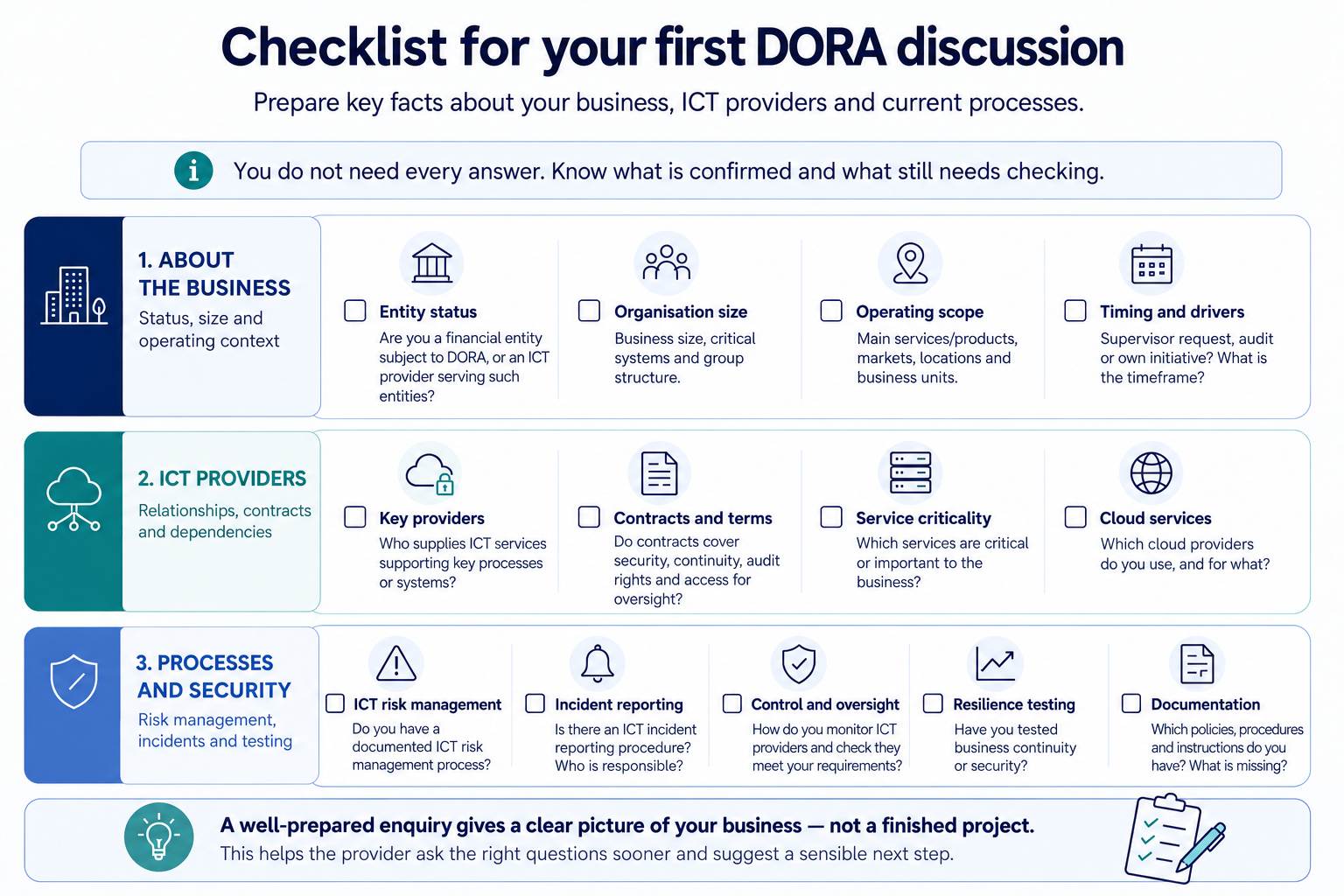
Open the image to see the original diagram in full size. It covers entity status, ICT suppliers, risk, incidents and resilience testing.
What to establish before the discussion
Before sending an enquiry, it helps to divide the issue into distinct areas. You do not need complete answers, but you should know which facts are available and which still need gathering.
| Area | What to establish | Why it matters |
|---|---|---|
| Entity status | Whether the organisation is a DORA-covered financial entity or supplies ICT services to covered financial clients | Determines the potential scope of duties and the type of conversation |
| Organisation scale | Size, number of critical systems and group structure | Helps account for proportionality |
| ICT suppliers | Providers supporting key systems, including cloud suppliers | Supplier agreements are a major DORA workstream |
| Risk management | Whether a documented ICT risk-management process exists | Shows whether the starting point is a new system or an update |
| Incidents | Whether there is an ICT incident reporting procedure | Indicates if response and reporting need to be improved |
| Resilience testing | Previous business continuity and security testing | Helps define further testing work |
| Deadline | Whether pressure comes from supervision, audit or an internal decision | Helps prioritise the initial discussion |
This is not legal or technical advice. Its purpose is to avoid beginning the first conversation with basic questions the organisation could have answered itself.
ICT suppliers are a separate workstream, not an afterthought
A common mistake is to treat suppliers as a minor detail. In practice, third-party ICT risk is central to DORA. The regulation places considerable emphasis on how a financial entity manages its relationships with ICT service providers, especially those supporting critical or important functions.
Before speaking to a specialist, prepare at least a provisional list: who hosts the systems, who provides essential software, whether these are one-off providers or long-term partners, and whether the existing contracts address security, continuity and audit rights.
If you have no complete register, you need not finish it before the initial enquiry. Stating that this area has not yet been mapped is itself useful information.
Assessment or implementation quote?
If the organisation is uncertain whether and how DORA applies, or does not know its current ICT risk-management maturity, a DORA readiness assessment may be the natural first step. It helps separate established processes from those requiring work.
If the organisation understands its status and areas for improvement, and wants to establish deliverables, a timetable and approximate terms, a DORA implementation quote may be more appropriate.
DORA project scope is seldom determined by company size alone. Critical suppliers and the maturity of documented ICT risk management often matter more.
Short checklist before sending an enquiry
- Is it clear whether the organisation is directly covered by DORA or acts as an ICT supplier to a covered entity?
- Is there a list of ICT suppliers supporting critical systems?
- Does a documented ICT risk-management process exist?
- Is an incident-reporting procedure in place, or does it need to be created?
- Have digital resilience or security tests been conducted?
- Is the deadline driven by a supervisor, an external audit or a management decision?
- Who coordinates the project and has access to information from IT, compliance and legal teams?
Common mistakes at the outset
The first mistake is asking only about IT systems, with no mention of suppliers and contracts. DORA deals extensively with third-party relationships; leaving them out can lead to an overly narrow service proposal.
The second mistake is not distinguishing a financial entity from an ICT service provider. These are two different perspectives requiring different questions.
The third mistake is treating DORA as purely technical, with no involvement from procurement, legal or risk-management colleagues. The necessary information usually sits across several departments.
Example of a weak and a better enquiry
Weak enquiry:
We need to implement DORA. Please send a quote.
Better enquiry:
We are a financial institution using several cloud providers for critical systems. We have basic security procedures, but ICT risk management is not yet formally documented and our incident-reporting procedure is unclear. We want to understand how far we are from readiness and which areas should take priority.
The second enquiry does not yet settle the work specification, but it explains the supplier environment, current processes and the purpose of the discussion. The specialist can ask the right questions sooner instead of beginning with definitions.
Summary
A DORA discussion is more productive when a financial organisation can describe both its own situation and the ICT supplier environment: who supports critical systems, which contracts exist and how ICT risk management is organised today.
Complete answers are not necessary before first contact. What matters is knowing what is already in place, what remains unclear and whether the right first step is an assessment or a discussion of implementation scope and terms.